


Exhibitions
MOMAT Collection(2026.5.26–9.13)
Date
-Location
Collection Gallery, from the fourth to second floors
Highlights
Welcome to the MOMAT Collection!
To introduce some features of the museum’s exhibitions of works from the collection: First, its scale is one of the largest in Japan, displaying approximately 200 works each term from the museum’s holdings of approximately 14,000 works acquired since its opening in 1952. Also, it is one of the foremost exhibitions in Japan, tracing the arc of Japanese modern and contemporary art from the end of the 19th century to the present day through a series of 12 rooms, each with its own specific theme.
Some highlights of the current term are as follows. The ability to present exhibits in the collection galleries that connect with special exhibitions on the first floor is one of the strengths of this museum’s holdings. This time, using Room 8, Room 9, and part of Room 10 on the third floor, we present exhibits in conjunction with Hiroshi Sugimoto: Extinction (opening June 16). Meanwhile, many newly acquired works are also on view this term. Look for the “New Acquisition” markers next to each work.
We hope you enjoy this rich lineup of works from the MOMAT Collection, where longtime highlights are joined by fresh new faces.
National Important Cultural Properties on display
The National Museum of Modern Art, Tokyo Collection contains 18 items that have been designated by the Japanese government as National Important Cultural Properties. These include twelve Nihon-ga (Japanese-style) paintings, five oil paintings, and one sculpture. (One of the Nihon-ga paintings and one of the oil paintings are on long-term loan to the museum.)
The following National Important Cultural Properties are shown in this period:
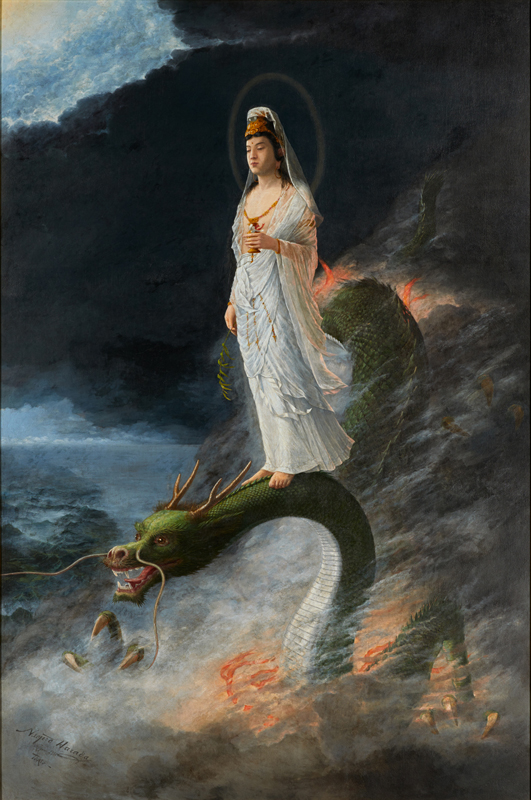
- Room 2 Harada Naojiro, Kannon Bodhisattva Riding the Dragon, 1890, Long term loan (Gokokuji Temple Collection)
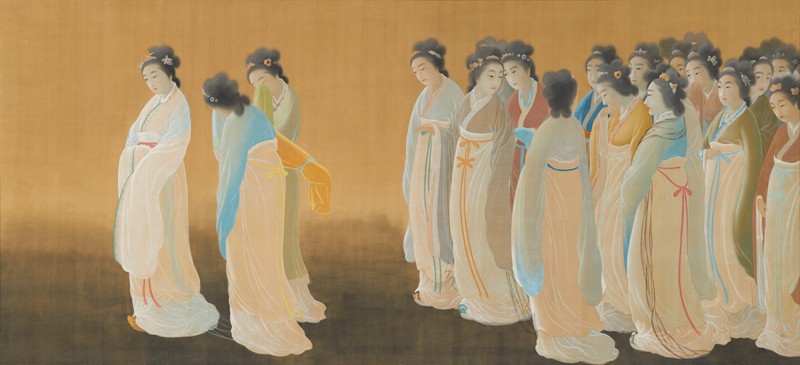
- Room 2 Hishida Shunso, Wong Zhaojun [the Chinese princess], 1902 Long term loan (Zenpo-ji Temple Collection)
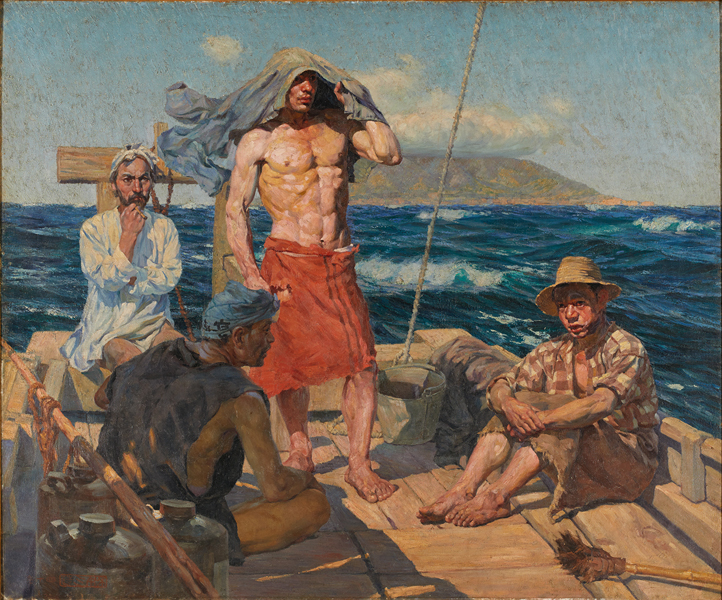
- Room 2 Wada Sanzo, South Wind, 1907
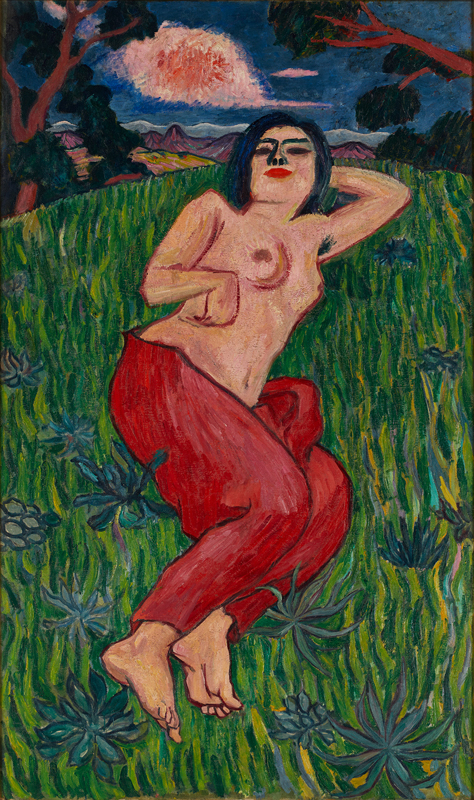
- Room 3 Yorozu Tetsugoro, Nude Beauty, 1912
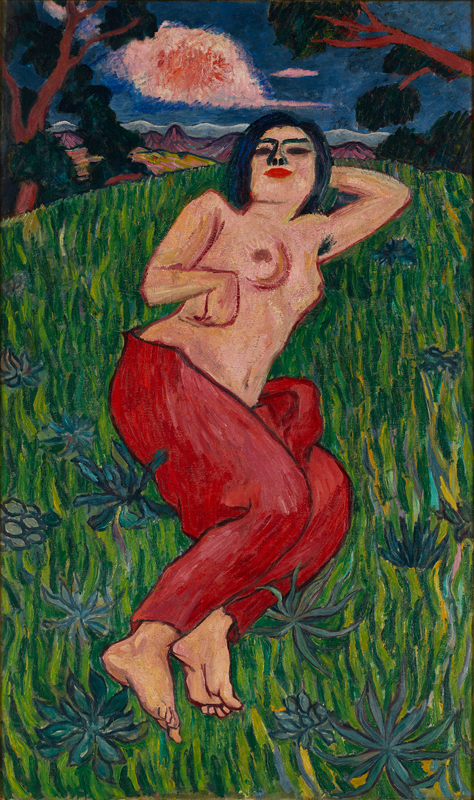
Nude Beauty, 1912
About the Sections
4F (Fourth floor)
A Room With A View
Located on the top floor of the museum, the rest area is furnished with Bertoia chairs, which can be compared to masterpieces of chair design. Please relax by the bright window. The large windows offer panoramic views of the greenery of the Imperial Palace and the Marunouchi skyline.
Information Section
Located in the introductory area, the Information Section presents a chronology of the MOMAT’s history, along with related materials. The materials on display are constantly being changed, so don’t miss them. The section also provides information on exhibitions at other museums that include works on loan from our museum, as well as a system for searching for works in our collection.
Room 1-5 1880s-1940s
From the Middle of the Meiji Period to the Beginning of the Showa Period
Room1 Highlights
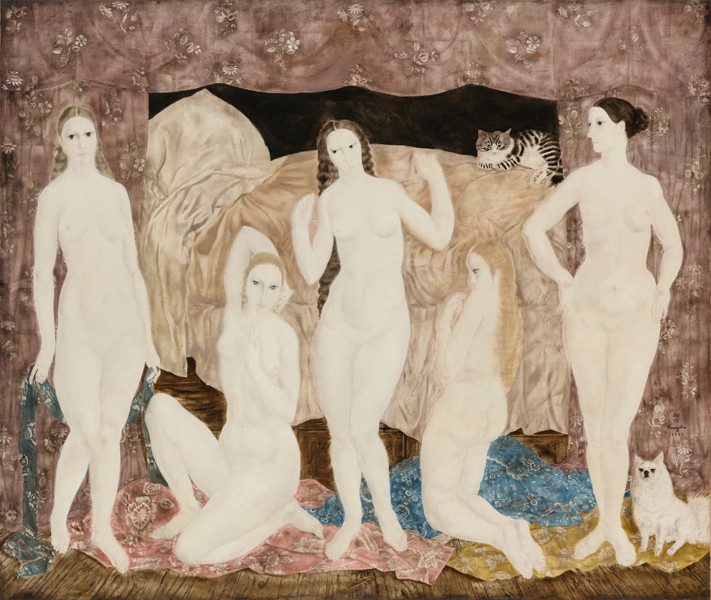
The MOMAT Collection exhibition of works from our permanent holdings features nearly 200 items in a 3,000-square-meter space. The “Highlights” section of this exhibition features highly prized works of modern and contemporary art that showcase the strengths of our collection. This term, we invite you to focus on Nihonga (Japanese-style painting). The first term (through July 20) features Kitano Tsunetomi’s For Fun (1929) and Ogura Yuki’s Bathing Women (1938) and After Bathing (1939). In the second term (from July 22), the works include Fukuda Heihachiro’s Rain (1953). All are among the most popular works in the museum’s Nihonga collection. Outside the display cases, Fujita Tsuguharu’s Five Nudes (1923), much sought after for exhibitions around the country, has returned to the MOMAT Collection exhibition after an absence of roughly three years. We hope you will take your time and enjoy all of these, along with perennial favorites in this room by Paul Cézanne, Pierre Bonnard, and Paul Klee, as well as Nara Yoshitomo’s Harmless Kitty (1994), which remains on view from the previous term.
Room 2 Clouds above the Hill
Through Japan’s victories in the First Sino-Japanese War (1894–95) and the Russo-Japanese War (1904–05), the country revised an unequal treaty with the world’s great powers and acquired the status of a completely independent nation. Regarding itself as the leader of a new order in East Asia, this marked Japan’s burgeoning awareness as a major world power. As Shiba Ryotaro wrote in Clouds above the Hill, this was the point at which the image of Japan as a modern nation – a status the country had pursued since the Meiji Restoration – was realized. This also signified that Japan had taken the first step toward becoming an empire. After the Russo-Japanese War, Japan annexed Korea in 1910 and established a foothold to advance into the Chinese mainland.
The Bunten exhibition, sponsored by the Ministry of Education, Science, and Culture, was launched not long after the Russo-Japanese War in 1907. Among the displays in the first installment were works such as Wada Sanzo’s South Wind, which captured the spirit of the times through a heroic masculine image. But at the same time there was a surge of dissatisfaction with the government, which had burdened the nation with its military pursuits. The weight of public interest gradually shifted away from the nation to the individual.
Room 3 The Sun and I
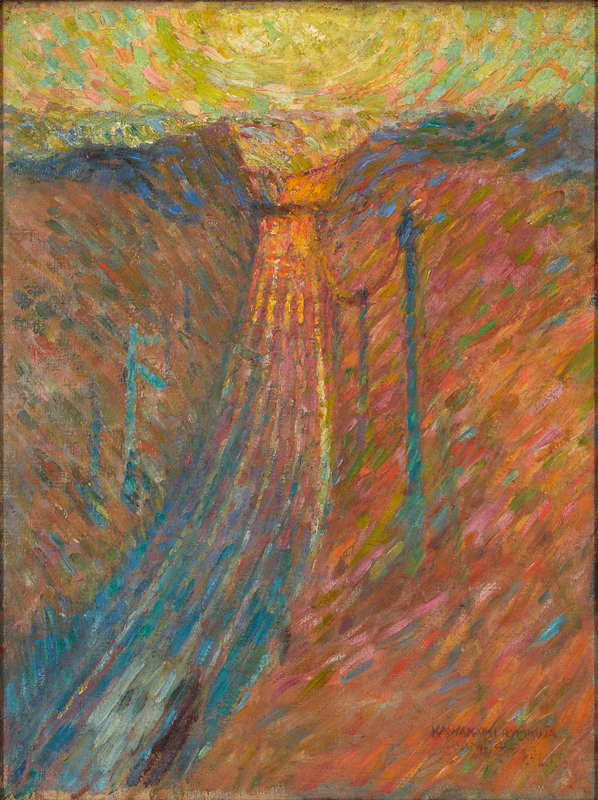
“I am searching for absolute freedom in the art world. Thus, I am attempting to recognize the infinite authority of the artist’s Persoenlichkeit [personality]…. Even if someone painted a green sun, I would not criticize them.” This is a passage from “Green Sun,” an essay written by Takamura Kotaro in 1910. Extolling an absolute way of seeing and feeling that would even allow an artist to alter the nature of the outside world, the text heralds the start of Taisho Democracy. Underlying this example of depicting the sun (which would usually be red in Japan) with the complementary color of green, is a van Gogh work in which the artist used the complementary colors of orange and blue to paint the sun. Shirakaba, a magazine that was also launched in 1910, often featured plates of van Gogh’s works. With his glowing colors (even though the reproductions were monochrome), thick paint that conveyed a breathtaking sense of speed, and a tragic life during which he received little understanding from other people – van Gogh instantly became an emotional “sun” illuminating the “I” (or the self) of young artists with a relentless desire to expand themselves.
Room 4 Shin-hanga Crosses the Ocean
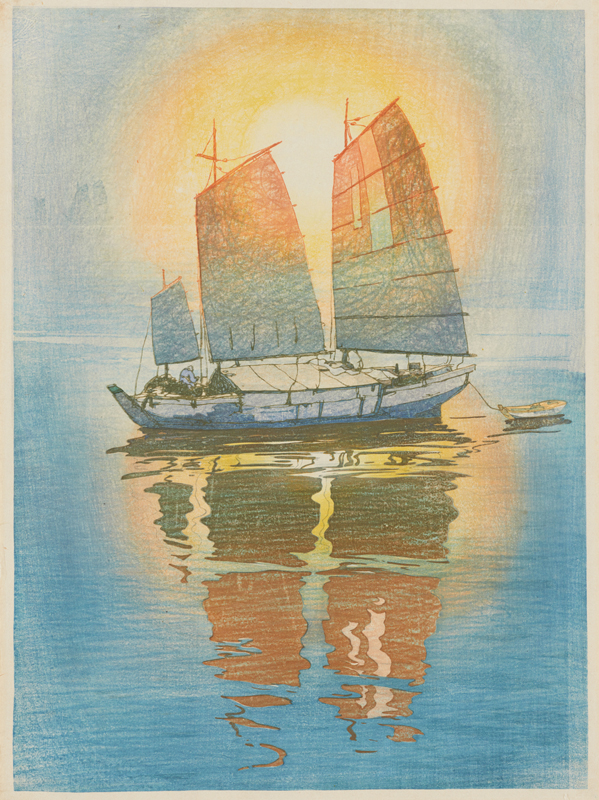
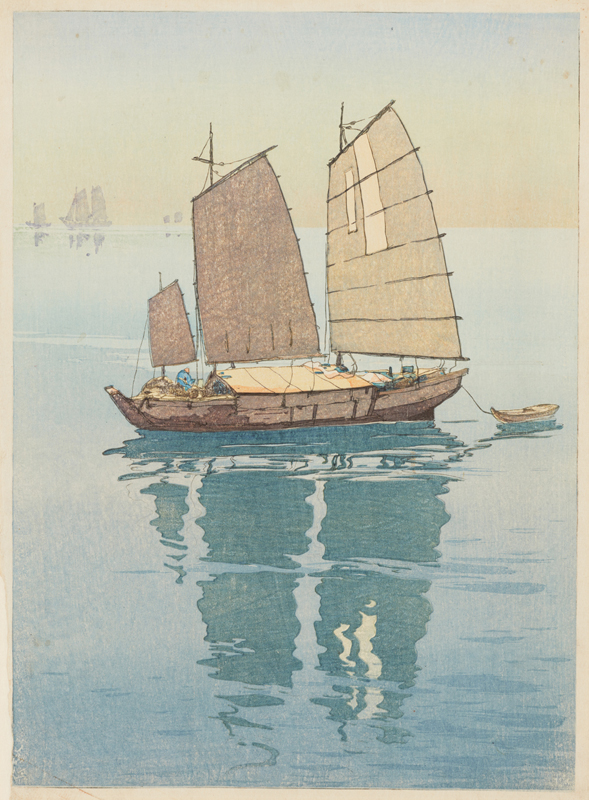
Shin-hanga (New Prints) emerged in the Taisho era (1912–1926) and were produced using the same collaborative division of labor as ukiyo-e, with the goal of reviving and modernizing that tradition. Today, shin-hanga works are in the collections of many museums and individuals overseas. In fact, large-scale traveling exhibitions in the United States helped raise the movement’s profile as early as 1930 and 1936. Each exhibition featured 10 selected artists and around 300 works. The prints covered a broad range of genres, including landscape, bijinga (images of beautiful women), actor portraits, and bird-and-flower prints, and many depicted subjects associated with Japan. Because most of the works on view could be ordered from the publishers, large numbers of prints were exported to the US. Although there were plans to hold shin-hanga exhibitions there every five years after 1936, the worsening international climate as Japan moved toward war prevented their continuation. In this room, we revisit some of the prints seen by American viewers at the time, including works by Yoshida Hiroshi, who played an active role in the exhibitions both as a participating artist and as an intermediary.
Room 5 Landscape Mobilized in Wartime
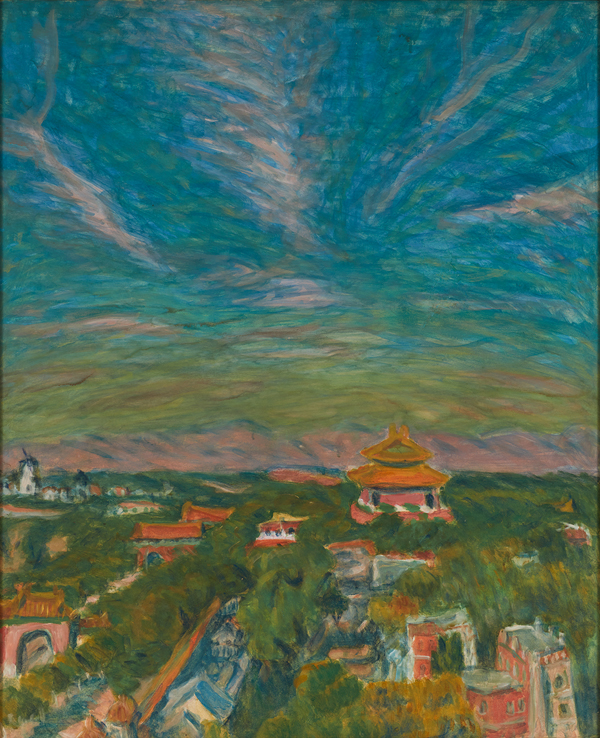
For people living in Japan, an island nation, the endless horizons and vast blue skies of the Asian continent symbolized a distant, alluring elsewhere. From the Meiji era (1868–1912) onward, as Japan colonized Taiwan and Korea and expanded its reach into Asia, that gaze rapidly acquired overt political overtones. For example, in the Forbidden City in Peking (present-day Beijing) as painted by Umehara Ryuzaburo during the war years, viewers at the time would have perceived both exoticism and territorial expansion.
To cross the sea as a soldier was synonymous with laying down one’s life for Japan’s war effort. Artists Ai-Mitsu and Asahara Kiyotaka were conscripted and sent to the continent, where they died. A verse by Otomo no Yakamochi, the model for Tsuji Shindo’s carved wood sculpture, which was included in the ancient poetry anthology Man’yoshu, was set to music and sung as the popular patriotic song “Umi Yukaba” (If I Go Away to the Sea). During World War II, “Umi Yukaba” became the customary requiem accompanying broadcasts reporting gyokusai (mass death in battle). Landscapes of the continent and the sea came to be more than beautiful scenes to contemplate, and were mobilized as devices that drove people toward the front.
3F (Third floor)
Room 6-8 1940s-1960s From the Beginning to the Middle of the Showa Period
Room 9 Photography and Video
Room 10 Nihon-ga (Japanese-style Painting)
Room to Consider the Building (Sol LeWitt, Wall Drawing#769)
Room 6 Dreams of Steel, Wounded Ruins
Photography by Otani Ichiro
Vast expanses of sea in Navy Operation Record Paintings and gripping battle scenes of warships stirred the imaginations of boys raised in a militarized society. Alongside illustrations of science-fictional weapons published in the magazine Kikaika (Mechanization), such images fueled their dreams and aspirations. With Japan’s defeat in 1945, however, those fantasies collapsed. Furusawa Iwami’s Starveling reflects the immediate postwar mood all too clearly, depicting wounded veterans and sex workers standing amid a city reduced to rubble.
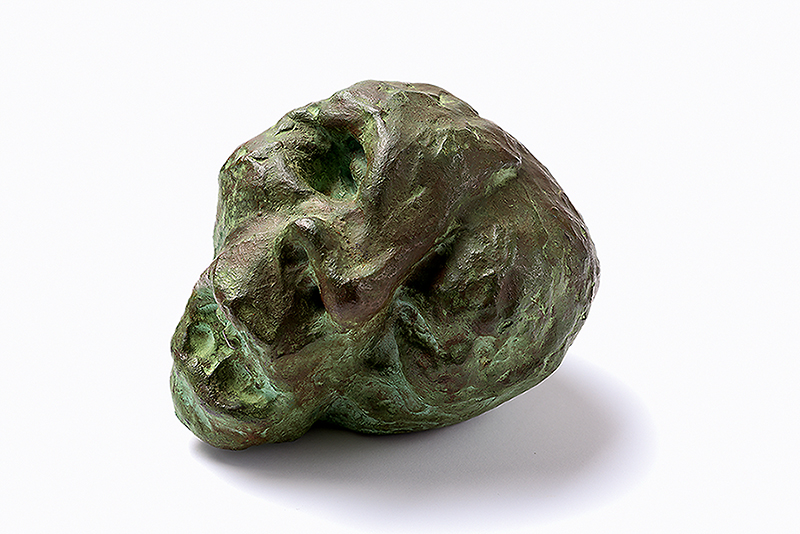
After World War II, as the economy moved toward recovery driven by a surge in demand related to the Korean War, artists turned their gaze to the suffering human body, as if fighting the prevailing tide of historical amnesia. Tsuruoka Masao’s Lying Head and Urushibara Hideko’s Midnight Circus, both recently added to the collection, are emblematic of the distorted and fragmented body imagery that emerged in postwar Japan. In this room, we reflect on memories of war, tracing the evolution of imagery from rousing propaganda to wounded flesh.
Room 7 Navel Surgery
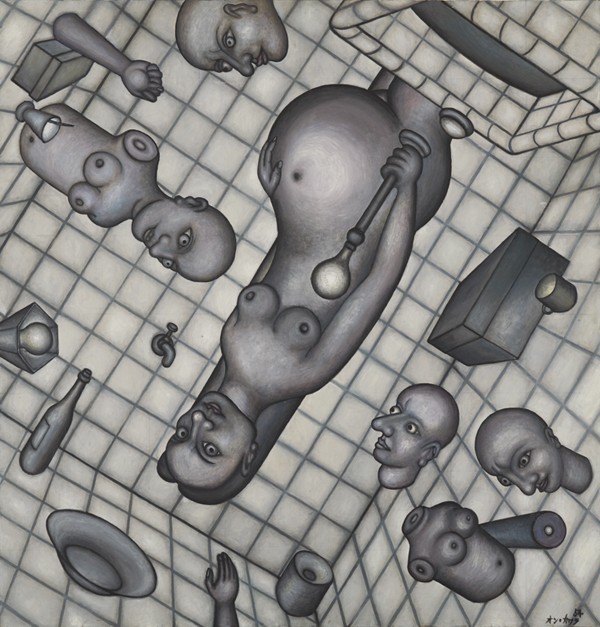
Last year, the museum acquired Flood, an important early work by the internationally renowned Japanese artist Kawara On. Marking its public debut, this exhibit focuses on avant-garde practices in postwar Japan.
Drawing on “Polarism,” the postwar artistic philosophy proposed by Okamoto Taro that sought to generate new value by allowing opposing elements to coexist in unresolved contradiction, Kawara referred to his own extension of this approach as “navel surgery.” As he put it, it was an effort to “destroy the tepid (…) spatial forms of the past and further sharpen the contradiction and opposition between the viewer’s vision and the painting.” A magazine article in which he fully disclosed his process of dismantling the central point, the “navel,” of the picture plane clarifies why he frequently employed shaped canvases during this period. By breaking down the symmetry of the picture plane and attempting to reshape the viewer’s gaze, Kawara aligned himself with contemporaries who shared similar concerns, including Nakamura Hiroshi, who made use of montage; Yamaguchi Katsuhiro, who set the viewpoint in motion rather than fixing it in place; and Miyawaki Aiko, whose works quite literally dispense with a center.
Room 8 Materialization or Dematerialization?
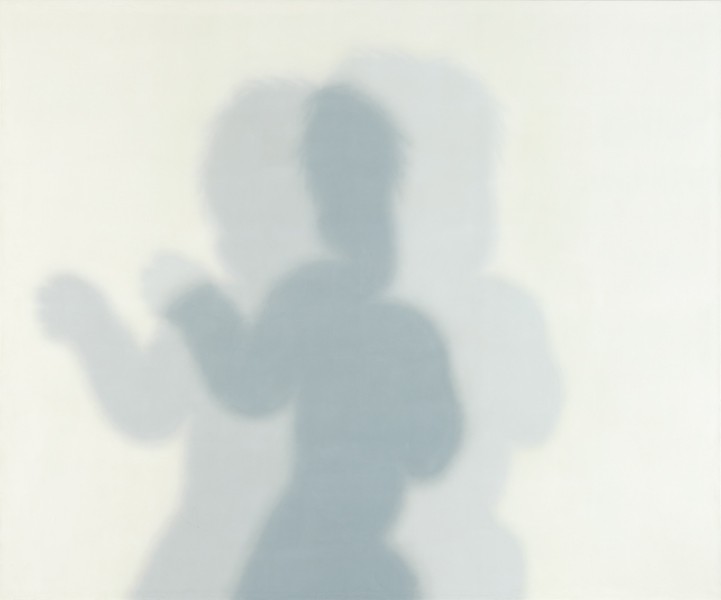
In conjunction with Hiroshi Sugimoto: Extinction, on view on the first floor, this area features art primarily from the 1970s. Sugimoto moved to the United States in 1970 to study photography, marking the start of his career. Around this time, the “dematerialization of art” was a tendency emerging worldwide. As identified by the American critic Lucy R. Lippard, this tendency for artists to foreground essential concepts, rather than pleasing the eye with material and visual elements such as skillful technique or formal construction, subverted the image of artworks as one-of-a-kind commodities and led to the rise of Conceptualism. Many artists eliminated color, and often turned to print processes to introduce an indirect mode of production, creating distance from materiality. Even so, a work of art cannot escape its status as a material thing. The challenging and exploratory aspects of using material to subvert materiality, or of presenting material itself as concept, can be seen, for example, in the notes accompanying preparatory drawings for a work by Takamatsu Jiro.
Room 9 Video (I See)
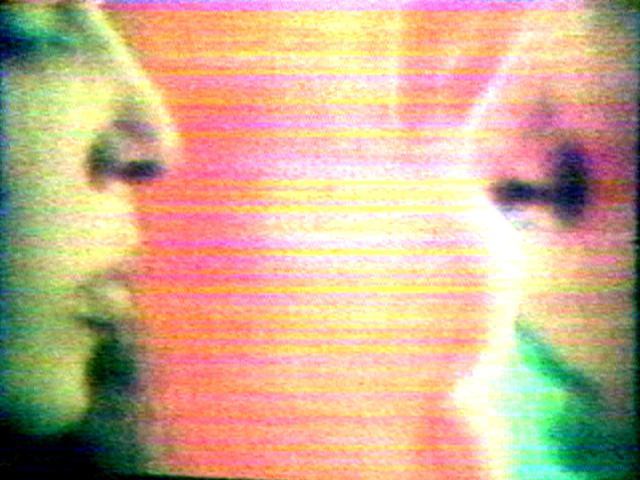
Courtesy Electronic Arts Intermix (EAI), New York
The term audio (Latin for “I hear”) originated in the early 20th century as a technical term for sound signals. Its counterpart, video (likewise, “I see”), came to be used for visual signals. When portable video cameras were developed in the 1960s, artists seized on the new equipment to explore uncharted creative territory. In this room, we present three landmark works from the early 1970s, the formative years of the medium.
Video’s unique mechanical structure, which converts visual images into signals that can immediately be played back, means that the person filming can continuously review their own footage. Because video literally means “I see,” the name has a built-in duality: seeing is equated with video, even as video as a medium defines and regulates the act of seeing. In response to this self-referential quality, many works turned the camera into a mirror, reflecting on who is seeing and what is being seen. The frequent appearance of the artists themselves in early video art can be attributed less to their being the most readily available model than to this inherent characteristic of the medium.
Room 10 (Dates: May 26-July 20) Theaters, Seascapes, and Sugimoto Notebooks / Seeing the Wind
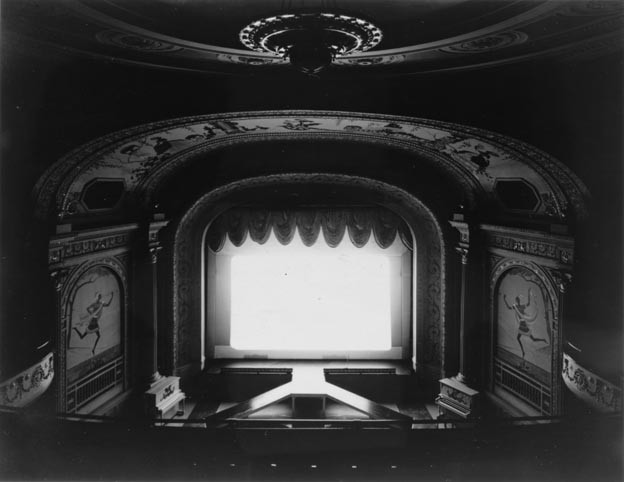
Koyanagi
In the front area, as a satellite exhibit for Hiroshi Sugimoto: Extinction, on view in the first-floor Special Exhibition Gallery, we present 13 works by Sugimoto from the museum’s collection along with notebooks documenting his creative process. Theaters and Seascapes series, known as landmark early series, are both conceptual in nature, yet the notebooks on display here reveal the importance of the visual dimension, showing that Sugimoto engaged in extensive trial and error in the darkroom as he strove to perfect his prints.
The room at the back focuses on wind and the subtle movement of air. Modern Nihonga (Japanese-style painting) artists, on the whole, sought to move beyond established pictorial conventions, yet they did not abandon the traditional sensibility of appreciating kachofugetsu (“flowers, birds, wind, and moon,” i.e. the beauty of nature). The works assembled here, spanning from the Meiji era (1868–1912) to the Heisei era (1989–2019), all engage in some way with the theme of wind. In these varied treatments, what new forms of modern expression and what fresh readings of tradition can be seen?
Room 10 (Dates: July 22-September 13) Theaters, Seascapes, and Sugimoto Notebooks / Birds in Modern Nihonga
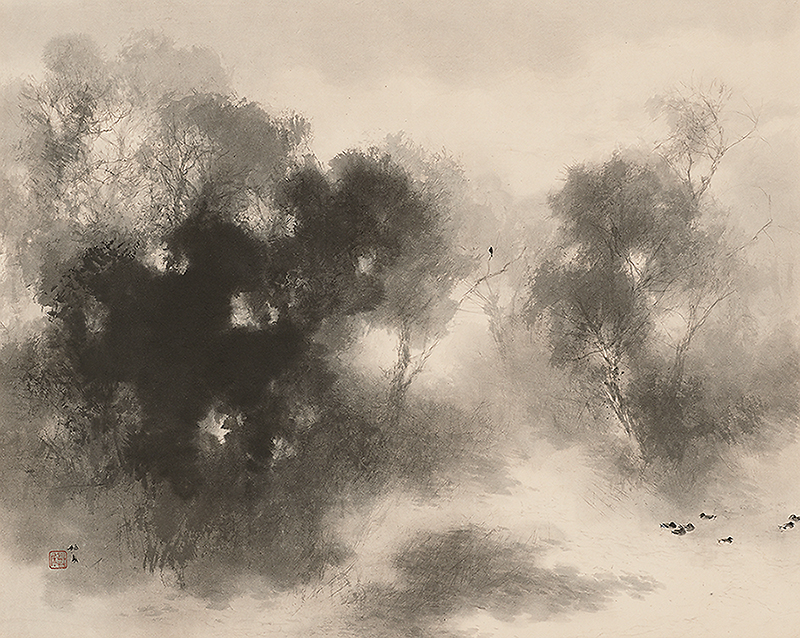
In the front area, as a satellite exhibit for Hiroshi Sugimoto: Extinction, on view in the first-floor Special Exhibition Gallery, we present 13 works by Sugimoto from the museum’s collection along with notebooks documenting his creative process. Theaters and Seascapes series, known as landmark early series, are both conceptual in nature, yet the notebooks on display here reveal the importance of the visual dimension, showing that Sugimoto engaged in extensive trial and error in the darkroom as he strove to perfect his prints. In the back room, following the first-term focus on wind, we turn to Nihonga (Japanese-style painting) depicting birds, another element of kachofugetsu (“flowers, birds, wind, and moon,” i.e. the beauty of nature). Birds, familiar to us in everyday life, have appeared in Japanese painting since ancient times. In seeking to move beyond the conventions of traditional bird-and-flower painting, modern Nihonga artists isolated birds to explore new approaches to form and composition, or introduced them into landscapes to bring a sense of life to the scene. What signs of modern sensibilities can be found in the birds seen here?
2F (Second floor)
Room 11–12 1970s–2020s
From the End of the Showa Period to the Present
Room 11 Images: Appearance and Disappearance
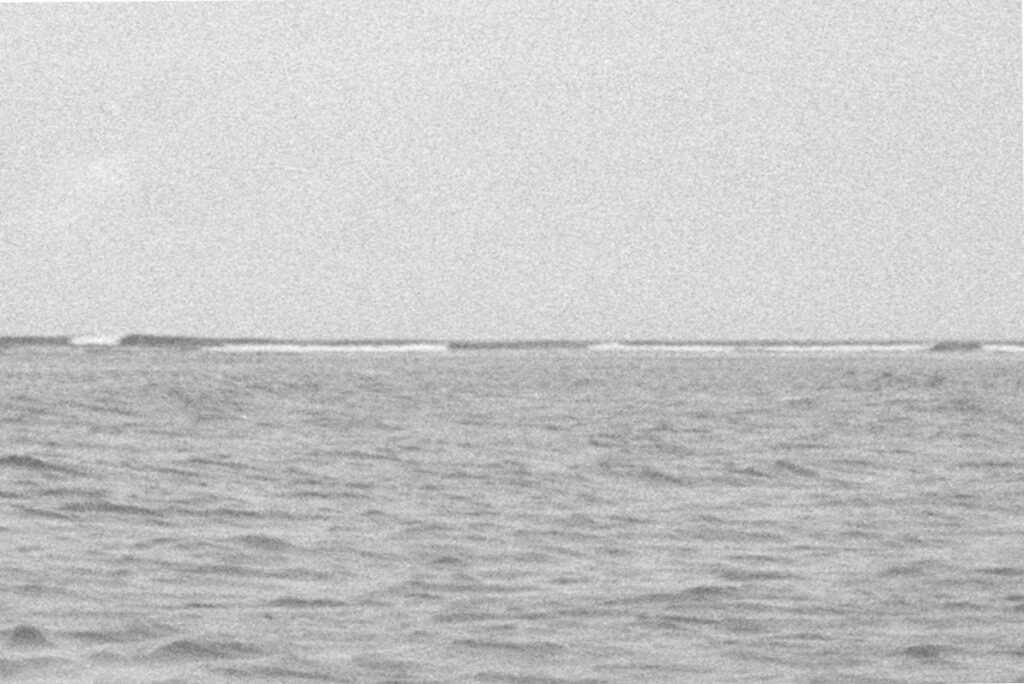
For the first time since its acquisition, we present Yokomizo Shizuka’s video installation That Day (2020). In conjunction with its debut, this exhibit also features several works that adopt the perspective of the appearance and disappearance of images.
In Yokomizo’s video, which follows the photographic developing process, the fixing of the image on paper (appearance) and the fading of memory (disappearance) are framed as two sides of the same process. In the paintings of Kobayashi Masato, the viewer witnesses the arrival of the image of “sky,” even as the material presence of paint and canvas seems to recede. In the drawings of Roland Flexner, the instant a soap bubble bursts and disappears, an image surfaces as a lingering trace. This theme of the appearance and disappearance of the image connects loosely to the video piece by Bill Viola in Room 12.
In physical terms, works of art are unmistakably present in front of the viewer. Their images, however, prove far less reliable than they may seem. When, and in what manner, do images emerge and vanish before us?
Room 12 Image: The Power Within
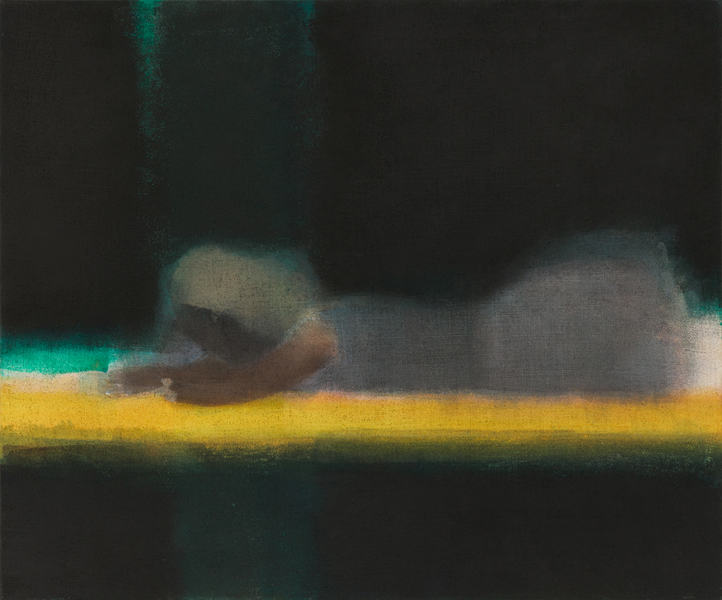
Bodies in the works on view here appear fragmentary, insubstantial, or somehow hollow. A work by Shirai Mio is made from artificial human hair; a ghostly dress by Maemoto Shoko reflects her own existential and physical anxiety and conflict; phallic forms proliferate in Kusama Yayoi’s a soft sculpture, created to overcome her fear of men. The faceless figures and wounded animals depicted by Murakami Saki are connected to anxieties and traumas buried deep within the artist’s psyche. A girl painted by Ikemura Leiko lies as if drifting between consciousness and unconsciousness, waking and sleep. The indistinct figures of refugees painted by Miriam Cahn keep moving forward, wandering with no direction home. The bodies depicted in these works, while lacking substance, convey a power within: a will to go on living even while undergoing oppression, unease, pain, and fear. In Bill Viola’s video The Reflecting Pool, a man’s body gradually fades from the screen over time, yet it is precisely this disappearance that generates a powerful tension within the image.
Hours & Admissions
- Location
-
Collection Gallery, from the fourth to second floors
- Date
-
May 26, 2026–September 13, 2026
- Closed
-
Mondays (except July 20), July 21
- Time
-
10 am–5 pm (Fridays and Saturdays open until 8 pm)
- Last admission: 30 minutes before closing.
- Admission
-
Adults ¥500 (400)
College and university students ¥250 (200)- The price in brackets is for the group of 20 persons or more. All prices include tax.
- Free for high school students, under 18, seniors (65 and over), Campus Members, MOMAT passport holder.
- Show your Membership Card of the MOMAT Supporters or the MOMAT Members to get free admission (a MOMAT Members Card admits two persons free).
- Persons with disability and one person accompanying them are admitted free of charge.
- Members of the MOMAT Corporate Partners are admitted free with their staff ID.
- Including the admission fee for MOMAT Collection Focus (Gallery 4).
- Discounts
-
Evening Discount (From 5 pm on Fridays and Saturdays)
Adults ¥300
College and university students ¥150 - Organaized by
-
The National Museum of Modern Art, Tokyo